Wednesday, February 17, 2010

2-7 to 2-8-10 El Chalten, Argentina (pics of El Chalten, waterfall, and last 2 from lookout for Mt. Fitz Roy)


2-7-10: We set out for El Chalten today and quickly found lodging at the comfy and practical Cerro Torre Cabanas. The gusty, high winds typical to this area did not make camping a viable option since most of the campsites were exposed and wind-whipped. We spent 2 days here to enjoy Argentina's Trekking Capital; named such due to the wide range of outdoor activities one can partake in. El Chalten is located within Los Glaciares National Park and it's named for Mt. Fitz Roy's Tehuelche name meaning ' peak of fire' or 'smokig mountain'; an apt description of the often cloud-enshrouded summit. On the 7th, we walked a short hike to see the waterfall Chorrillo del Salto. As I admired the falls from a sunny perch at the base, Mike and the kids scrambled across the stream for some climbing which led them to a vantage point above the falls.

2-8-10: Today we took a longer hike to Laguna Capri and the mirador for Mt. Fitz Roy. We waited about an hour to see if the clouds would clear enough for a good view of the elusive peak but they would only tease us with brief glimpses. The family returned to our cabana from our hike just in time as the sunny, warm weather turned cold, gusty and rainy.

Friday, February 12, 2010

2-1 through 2-6-10 Torres del Paine Park (Chile)


2-1-10: We parked our car at the trailhead, packed our backpacks (Gaby and Luke were also carrying backpacks containing their sleeping bags and foam pad) then headed up the trail. We hiked 4.2 km with a steep ascent and a windy section just before hitting Refugio Chileno to set up camp; it took us about 2 hours to this point.
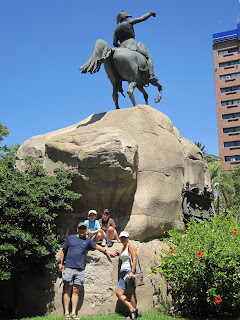
2-2-10: We continued our trek to Mirador Torres (4.8 km sans backpacks except for daypacks Mike and I were carrying). The granite towers of Torres del Paine, the surrounding mountains, and light green waters of the glacial lake were an amazing site although clouds tended to obscure the peaks of Torres most of the time. Luke and Gaby had a blast scrambling over large boulders (see the big boulder picture and pick out the kids to the right of it) and even discovered a neat cave that Mike and I had to see. After a couple of hours, the kids and I decided to begin our descent while Mike lagged behind to enjoy the views and peaceful solitude just a bit longer. We spent another night at our same camp.

2-3-10: We hiked back to the trailhead this morning and bid Torres del Paine Park goodbye as we headed back to Puerto Natales.

2-4-10: The Cueva del Milodon (cave of the Mylodon) warranted a visit before leaving the Puerto Natales area. It is a huge cave (30 m high) where the remains of a giant ground sloth creature were found in the 1890s. Mylodon is an extinct genus of giant ground sloth that lived in the Patagonia area of South America until roughly 10,000 years ago. Mylodon weighed about 200 kilograms (440 lb) and stood up to 3 m (10 ft) tall when raised up on its hind legs. Preserved dung has shown it was a herbivore. It had very thick hide and had osteoderms within its skin for added armor. The Mylodon museum had a small piece of the Mylodon's hide with fur still attached and some of its bones. After completing out tour of the cave and museum, we loaded up in the car and crossed back into Argentina with a planned destination of El Calafate. We took a wrong turn at one point and nearly found a new crossing back into Chile except for the road ending at the base of the mountains which effectively blocked our passage (ha,ha). Thus we turned around, ran into a couple of ranchers checking on their sheep who pointed out our wrong turn, and ended up on their estancia for the night since we wouldn't make El Calafate before nightfall. Their estancia, Rupai Pacha, had a nice campsite which made for a cozy stay. The next morning we chatted with our hosts and had a little tour explaining the history of their estancia as well as the inner workings of their sheep ranch. We were invited to their large garden to pick a small basket of organic starwberries for our road trip; what great hospitality!

2-5-10: We arrived at El Calafate and spent 2 nights here. Downtown Calafate had a nice mix of resto-bars, eateries, coffee shops, chocolate shops, souvenir shops, and bookstores.

2-6-10: Today's highlight was a trip into Parque Nacional Los Glaciares to view the amazing Glacier Perito Moreno; the park is 78 km from El Calafate. Glacier Moreno is among the Earth's most dynamic and accessible ice fields. It measures 30 m long, 5 km wide, and 60 m high but what makes it exceptional is its constant advance of up to 2 m/day, causing building-sized icebergs to braek off from its face. You could hear what sounded like a cannon shot as the glacier moved or broke off into the Lago Argentino!

Saturday, February 6, 2010

1-25 through 1-31-10 (Peninsula Valdes, Trelew, Cabo Dos Bahias, Pt. St. Julian)


1-25-10: We visited Reserva Peninsula Valdes today. There were informative displays at the Visitor's Center then we drove a 300 km loop on gravel roads to 4 major viewing areas. We saw Magellan penguins, elephant seals, sea lions, piche armadillos ('peludos'), guanacos (wild relatives of llamas), and Darwin's rheas (ostrich-like birds). We didn't see any Orca whales (which are actually dolphins not whales) although they had been spotted in the area the previous day. The main way to see them from shore is when they come up to the beach for a sea lion meal-to-go.

1-26-10: We made a return trip to Trelew to hit the Museo Paleontologico Egidio Feruglio (MEF). First we viewed an hour-long movie on how several factors (climate change, volcanic activity, the breaking apart of the supercontinent) helped create variety among the dinosaurs of the mid-Jurassic period. The displays of authentic fossils and dinosaur skeleton replicas were fascinating. We could also peer behind some glass windows demonstrating an actual lab; there wasn't much activity because the scientists were out in the field since it is summer here. The kids (as well as the adults) definitely thought this place was well worth a visit. That evening we drove to Camarones and camped out on the beach for 2 nights so we could visit Cabo Dos Bahias.

1-27-10: Today's highlight was exploring Cabo Dos Bahias Reserve. This is actually a less-traveled site for seeing a Magellan penguin nesting colony compared to Punta Tomba but we thought it was no less spectacular. We were able to walk along a fenced path in the midst of the colony. There were penguin parents and chicks everywhere; nesting in little dens in the arid ground, crossing under and over a wooden boardwalk as they freely moved about, and parents waddling out to sea to find food for their young. There were even guanacos walking nonchalantly among the penguins as you can see in one of the pictures above. On a nearby shore, we saw sea lions sunning themselves. We returned back to camp and an unexpected, strong gust of wind picked up our staked tent and blew it in cartwheels until Mike quickly nabbed it. We repositioned it beside the rental car to protect it from the fierce wind that battered our tent with sand all night. The next morning we spent most of the day driving to Puerto St. Julian. We had some pizza at a small bar overlooking the bay and as a tour boat returned back to its dock, Mike and I saw 1-2 tonina overas (Commerson's dolphins) as they spun their bodies just above the water's surface! They are known to be very playful and like to follow boats around.

1-28-10: Before leaving Puerto St. Julian, Luke and I took a guided tour of the Nao Victoria. This was 1 of 5 ships that arrived here in 1520 from Spain. The Portuguese explorer Ferdinand Magellan was at the helm as he searched for a passage between the Pacific-Atlantic Oceans. The true-to-scale replica of this ship recreated the people, animals, and interior of the original ship.

1-29 through 1-30-10: On 1-29 we continued south and drove from Puerto San Julian to Guer Aike. We spent the night at the rustic but cozy Hotel Guer Aike. Then 1-30 we crossed from southern Argentina into Chile! We spent the evening at Puerto Natales in the lovely Hostal Don Guillermo as we planned our subsequent trip into Torres del Paine National Park.

1-31-10: We entered Torres del Paine National Park and took in the spectacular mountains and turquoise blue-green glacier-fed lakes as we drove around. We camped at Hosteria Las Torres which was near the trailheadfor the 1st trail on the "W" hike circuit (east to west route).

Sunday, January 31, 2010

1-18 through 1-24-10 Lago Puelo National Park


1-18-10: We drove to one of the lakes surrounding Bariloche (Lago Gutierrez) and stayed 2 nights at Lago Gutierrez Hosteria. It was right on the lake and you could even descend some stairs to a small rocky beach. The views were gorgeous although it remained rather windy. The lake water was still too chilly for most folks although I did see a few hardy kids braving its temperatures and playing in the water for an extended period despite the blowing wind!
1-20 through 1-22-10: We left for El Bolson 1-20 and decided to stay at the lovely campground at Lago Puelo National Park which was about 17 km outside of El Bolson. On 1-21, we rode a boat to the far side of the lake called El Turbio and went on a guided hike to a glacier-fed stream then through a forest particular to this area. The next day we hiked up to the mirador (overlook) to enjoy the stunning views of Lago Puelo and the Andes mountain range.
1-23-10: We left camp and headed for Trelew where we spent the night. We were planning to go south from there to Punta Tomba (the largest Magellan Penguin nesting place) but changed our minds since we were told that Peninsula Valdes to the north was not to be missed. Thus we headed to Puerto Madryn and made it our home base for 2 nights; Puerto Madryn is about 100 km southwest of the Peninsula Valdes Reserve where Magellan penguins could be seen in addition to sea lions, elephant seals, guanacos, rheas, a long-haired relative of the armadillo, and possibly even Orca whales!

1-11 through 1-17-10 Bariloche, Argentina (pics of Bariloche, last 3 taken from Cerro Otto overlooking Bariloche)


1-11 through 1-17-10: We finally left our cozy hostel in Mendoza on 1-13-09. We took the 8 p.m. bus out of the terminal and arrived in Bariloche at 2 p.m. on 1-14-09. We were in a double decker bus with semi-reclining seats which made the long ride fairly comfortable. We found lodging at the MiraLago; separate apartments overlooking Lago Nahuel Huapi. We stayed 3 nights and walked down to the lake’s edge a couple evenings. The water was glacier melt cold but the kids waded into it anyway. We secured a rental car on 1-16 (it was difficult to get one earlier due to it being high tourist season). Shortly before picking it up, we rode the teleferico (gondola) to the top of Cerro Otto. The views were beautiful; mountains and lakes all around. On 1-17, we rode to Llao Llao Park for a short hike then returned to the Bariloche outskirts to camp at a campground for the night. We were camped beside the Brazo Campanario which is an inlet of Lago Nahuel Huapi which is huge (560 sq km and a max depth of 454 m)!

Monday, January 18, 2010

1-1 through 1-10-10 (pics of asado, various parks in Mendoza)


1-1-10: We flew out of Denver on an overnight flight to Buenos Aires, Argentina then caught a connecting flight to Mendoza the same day thus arriving in Mendoza 1-2-10. We stayed at the Cordon del Plata Hotel for 2 nights before switching to a lovely hostel on 1-4 called Quinta Rufina B & B/hostel. We were within 1 block of Aristides Villanueva Avenue which is a street famous for its eateries and hip bars. Our friend, Collin Hoffman, arrived from the U.S. on 1-3 since he and Mike were climbing 20,000 ft Cerro Plata (Cordon del Plata).


The following excerpt is Mike's account of their climb (1-4 to 1-7-10).


1-4-10: Oscar, the owner of our hostel drove Collin and me to Vallecitos, a ski area at about 9,700 ft. in the evening. We hiked up to about 10,500 feet and camped about 7:00 p.m. Our campsite was in a grassy meadow with some horses grazing nearby and a creek running through camp.


1-5-10 Collin and I hiked up to just over 14,000 feet to the top of a rocky prominence with just enough space for 8-10 tents. Since this spot is considered the base camp for Cerro Plata and several nearby 5,000 to 6,000 meter peaks, it was semi-crowded with several other climbing parties, mostly guided groups. There were Argentinian guides with several European groups and one Canadian group. My Spanish worked for most conversations but by the next evening French had taken over as the predominant language. We had no altitude or other health issues.


Collin wanted to go for the summit on the first good day; I thought a bit about acclimatizing but I felt so good that I also agreed to go for it in the a.m. if the weather looked good.


1-6-10: 5:00 a.m. found us awake, ready and rested thus we set off for the summit at about 5:15 a.m. A group of 7 or 8 guided climbers were right behind us. The sunrise found us at about 15,500 feet with the sun turning the high glaciers a pretty rose color (alpenglow). We slowly made our way up the mountain at about 1,000 feet an hour. At about 17,000 feet, we reached a ridge where we could see the other climbers way below us making their way up. The wind started to pick up at this elevation and Collin had a slight headache. He vomited once, then felt fine and we continued on. We felt great now and we both felt that the summit was a sure thing at this point. The next ridge we gained was about 17,500 feet; it seemed to connect Cerro Plato with Vallecitos and some other peaks. We could see the mighty Cerro Aconcagua (At 6,962 meters/22,841 feet, Cerro Aconcagua is the highest mountain in the Americas, and the highest mountain outside Asia) and many other Andean peaks from here. However the wind coming across this ridge was incredible. We continued slowly on an upward trajectory in this constant wind. There was no point where we could get out of the wind for even a brief respite. We were wearing everything we had packed and still our hands and noses were suffering from the cold. The wind was even strong enough to blow me sideways a couple of times; I estimated that it was gusting to 60 mph or so. Due to these conditions and with considerable regret, we turned around at 18,000 ft/5,500 meters with the summit in our sight. When we got back to the ridgeline, some of the guided climbers had made it to that point but none were venturing into the gale beyond it. That made me feel a bit better. It had taken us about 4-1/2 hrs to this point. We reached the basecamp at 14,000 feet at about 12:15 p.m.; about 7 hours after leaving in the morning. We spent the night here.


1-7-10: Collin and I continued our descent and reached a hostel below the ski area which was our starting point. (a 5000 ft descent). My quads were killing me. The downhill was a killer; we descended close to 9,000 feet in the last 24 hours. We ate well and we were happy!! Even though we didn't summit, we had hiked the entire ascent in 2 days with zero acclimatization -it was a true sprint! Up and down in less than 72 hours was a pretty good benchmark for an old man and a young gun new to high altitude.


1-5 to 1-6-10: While Collin and Mike were away, the kids and I walked to a nearby outside pool and cooled off from the intense heat (mid 90s F). The next day we took a taxi to the enormous San Martin Park which had a zoo. We saw black/grizzly bear, tigers, mountain lions or pumas, polar bears, an old wolf, toucans, etc. I wasn't impressed with the animals' care since we saw hunks of meat lying on the floor of the cages which were covered with flies. The seal exhibit was empty since their sole seal had recently died (bummer). Afterwards, we went shopping along Avenida Las Heras which is one of the main streets downtown.


1-9-10: Our hostel was family-run and Oscar and Mabel were our awesome hosts. They went out of their way to make our stay pleasant and helped us find local attractions. They were having an 'asado' or BBQ later this evening for family and friends and we were invited along with a couple of others staying at the hostel. It was held on the rooftop terraza of the hostel and it began at 10 pm; by the time the grilling was done, we ate dinner around 11 pm. It was a wonderful meal. In case you didn't know, Argentina is known for its delicious beef and late dining.